
Navigating the Sustainability Wave: A Complete Guide for Financial Advisors

Sustainable Investment Secret Shopper
According to the 2023 Investor Opinion Survey conducted by the Responsible Investment Association of Canada, interest in responsible investments continues to be high among retail investors. According to this study, which collected data from 1,001 individual investors, 65% of respondents express interest in responsible Investments. The study also reveals that 67% of respondents would like their financial services provider to inform them about responsible investing options aligned with their values. However, only 32% said their financial services provider had ever discussed the subject. The terms “responsible investment” and “sustainable Investment” are often used interchangeably when describing an investment approach that incorporates ESG data into the investment process.
The interest in sustainable investing mirrors that of investors globally. A recent Morgan Stanley survey of individual investors worldwide found that 77% were interested in sustainable investing.
Fifty-eight percent said that they would select a financial advisor based on sustainable investment offerings. In addition to investor appetites, there has been a regulatory movement in Canada to incorporate environmental, social, and governance considerations in client interactions.
Since December 2021, the Canadian Investment Regulatory Organization (CIRO) has included environmental, social, and governance considerations as part of the Know Your Client (KYC) process.
The CIRO guidance stipulates that in collecting KYC information, firms must gather data on various aspects, including a client's financial situation, personal circumstances, risk tolerance, intended investment timeframe, and the duration of investments. KYC guidance also emphasizes the necessity of factoring in the client's investment goals. Beyond conventional objectives such as preserving capital, generating income, and growing capital, the guidance recognizes "personal values" as an important motivator that should be taken into consideration.
According to CIRO, “Dealers should provide their clients with the opportunity to express their investment needs and objectives in terms that are meaningful to them, such as saving for retirement, to maintain a certain lifestyle, increasing wealth by a certain percentage in a specific number of years, investing for the purchase of a home, investing for the post-secondary education of their children, or investing following environmental, social and governance criteria or other personal preferences,” With the above in mind, and to better understand the state of integration of clients’ ESG priorities among Canadian financial advisors, ED4S embarked on a secret shopper campaign in the first two months of 2024.
In our secret shopper campaign, three ED4S associates posed as customers wishing to speak with an investment advisor about their investing needs. We looked to gauge whether an advisor would bring up ESG or sustainability issues unprompted, and if prompted, what expertise they could demonstrate in guiding our “shoppers” to make informed sustainable investment choices.
We wanted to understand not only the level of knowledge about ESG and sustainability issues among advisors in Canada but also the breadth of products their firms offered in the retail market and their willingness to suggest ESG and Sustainable investments to clients.
ED4S met with financial advisors representing a diverse cross-section of Canadian financial institutions, ranging from Canada’s largest financial institutions to boutique investment advisory firms with a handful of employees. We did so to ensure that we talked with a representative sample of the industry.

Key Findings
Our secret shopper mission revealed a mixed picture around the knowledge, willingness, and interest of financial advisors to speak about and propose sustainable finance products to our secret shoppers.
Only 20% of the advisors we spoke to brought up ESG or sustainability considerations without any prompts. After our secret shoppers showed indirect signs of interest in ESG investments, this metric improved to about 63% of advisors. These “prompts” included conversations initiated by our secret shoppers about sustainability issues or a wish to invest in sustainable investment solutions.
All mystery shoppers shared action around climate change as a primary concern. Only about 25% of advisors were able to discuss client goals and investment approaches around climate change.
About half of the advisors we spoke to demonstrated a sufficient understanding of different ESG investment approaches. Our secret shoppers judged the knowledge of an advisor “sufficient” if they demonstrated a basic understanding of sustainable investment issues or investment themes such as climate change, sustainable investing, or similar sustainability topics. We did not expect encyclopedic knowledge of sustainability issues from advisors, but rather the ability to understand a client’s ESG priorities and propose appropriate investment solutions.
he performance of sustainable investments was rarely discussed. If it was discussed, advisors generally claimed that sustainable fund performance was the same as the performance of other investments. The fees of sustainable investments were rarely discussed. More than half of the time, they were not discussed at all. When fees were discussed, they were presented as the same as other investment products.
While most of the advisors we spoke with offered some ESG or sustainable investment products, these were considered a good fit by our secret shoppers only about 17% of the time, and somewhat of a good fit 39% of the time.
For the most part, our secret shoppers were not convinced that advisors were able to discuss and recommend appropriate investment solutions for sustainability-motivated investors. Furthermore, our secret shoppers did not feel that the advisors they spoke with understood the secret shopper’s sustainability priorities and goals.
Discussion of ESG Issues
At first, our secret shoppers waited to see whether the advisors they met with brought up sustainability-related goals on their own (as part of their KYC process). If not, our secret shoppers hinted at their interest in ESG issues. Our secret shoppers then observed whether advisors asked open-ended questions to learn more about the needs of their potential clients.
It is worth noting that most advisors we met with (80%) rarely asked questions about client ESG goals without the secret shopper prompting them. These prompts consisted of our secret shoppers bringing up ESG or sustainability topics to signal that they were interested in sustainable investing.
For example, our secret shoppers might bring up the topic of wildfires in Canada and the environmental effects of the fires. Sometimes our secret shoppers brought up the prospect of buying an electric vehicle or mentioned that they wanted to responsibly build their savings or invest in ways that reflected their values.

However, after our secret shoppers showed interest in ESG issues, this changed, with 63% of advisors proceeding with ESG questions when prompted compared to 20% only before the prompt.

We believe open-ended questions are critically important, as they signal a genuine interest in understanding the client’s sustainability goals in accordance with KYC recommendation.

Each of our secret shoppers mentioned climate change as a concern. It was encouraging that about 25% of the advisors we met with discussed ways to address climate change in the investment process with our secret shoppers. However, no other ESG issues were discussed, (water, land use, biodiversity loss, plastic pollution) even if the client expressed interest in them.

We asked our secret shoppers to rate advisors on a scale of 1 to 5. This reflected whether our shoppers felt the advisor understood their ESG/sustainability goals (1 meaning no, and 5 meaning yes). Unfortunately, 60 percent of the time, our secret shoppers answered 1 or 2 to this question, demonstrating that most advisors did not adequately understand the goals of our secret shoppers.
According to one of our secret shoppers:
“Those who understood sustainability kept a conversation going, talking about the ESG products they had: mostly a low carbon mutual fund (less oil company presence and more financial weightings). Those who did not understand tended to redirect the conversation towards traditional products.”

Advisors ESG Knowledge and Sustainable Product Offerings
We wanted to better understand whether the advisors we contacted were knowledgeable about ESG and sustainable investing strategies, and if their firms had sustainable products to offer.
Our secret shoppers felt that less than half (45%) of the advisors they spoke with demonstrated an understanding of ESG investment approaches.
Our secret shoppers credited another 25% of advisors with being somewhat knowledgeable about sustainable investment approaches. About 30% of advisors did not demonstrate an adequate understanding of different ESG investing approaches.
One of our secret shoppers cited what their expectations were about sustainable products:
“I was hoping the advisor could show me investments in the following categories: Green Bonds, Sustainability mutual funds or ETFs, a green real estate fund, or a true impact fund.”

About 63% of the advisors we talked with discussed the performance of sustainable investments. Most of those discussing performance claimed that returns for sustainable funds were about the same as traditional funds. The real answer to this question depends on the timeframe, and how sustainable investment products are defined.
According to the latest assessment by Morgan Stanley, investing a hypothetical $100 into a sustainable fund in December 2018 would be up 35% if it had achieved the median return for each of the past five years. For traditional funds, that investment would be up 25%. However, what is considered a “sustainable” fund has been left up to investment firms until very recent efforts by regulators to better define what can be called sustainable or ESG funds. The historical record of “sustainability” fund performance is therefore not an exact science. The future is unknown, so we cannot predict what ESG funds will do in the future.
Issues such as climate change are likely to have a meaningful impact on investment portfolios due to increasing risks from extreme weather events, disrupted supply chains, and impaired assets, among other factors. Furthermore, the transition to a low-carbon economy, changes in consumer preferences, and sustainability-related regulation will also impact a multitude of industries, thus creating both risks and opportunities. Investment portfolios that do not account for such developments may underperform those that do over the long term.
Our secret shoppers judged whether the advisor’s knowledge of sustainable investments was “sufficient” based on the terminology and vocabulary the advisor used in conversation. Our secret shoppers did not expect advisors to be experts on climate change, or sustainability, but could tell by how an advisor spoke about sustainability issues whether or not they were sufficiently knowledgeable to offer our shoppers useful advice concerning sustainable investment decisions.

Although most advisors did not discuss the management fees of sustainable investments, those who did noted that fees for sustainable and traditional investment funds in Canada are not far apart. This appears to align with a 2020 Morningstar study which found that sustainable funds management fees were only 0.11 basis points higher than traditional non-sustainable funds. While this does mean that sustainable funds are generally more expensive, the difference is not significant.

Most of the advisors we talked to had sustainable investment solutions offered on their website (70%). This translated to about 59% having ESG or sustainable products to offer. Our secret shoppers felt these products were a good fit for them just over half of the time (56%). Although the number of sustainable investment products has grown in recent years, the current offering of sustainable investment products is still in its relatively early stages. There is an opportunity to enrich this offering to better meet client needs.


Our secret shoppers were skeptical that the advisors they met with could recommend appropriate investments to sustainability-motivated investors. When we asked our secret shoppers to rate on a scale of 1 to 5 how they would rate the ability of the advisor to recommend sustainable investments, the average score was only 2.42, with the most likely answer being 1 – or “not at all”.
One of our secret shoppers felt that financial institutions do not have products that aligned with his personal goal to combat climate change through his investments. Therefore, the ability of the advisors to recommend appropriate investment solutions seemed hampered by a lack of ESG or sustainability training and the lack of a top-down commitment to alignment with this key environmental issue.

On balance, our secret shoppers were not convinced that the advisors they met with could meet their investment suitability priorities or preferences. Our secret shoppers answered “maybe” to this question at a higher rate than “yes” or “no”. Our secret shoppers reported that only 50% of advisors demonstrated interest in sustainability.


Conclusions
Sustainable investment appears to be a secondary consideration, if not a niche asset class, among the majority of Canadian financial advisors. While many institutions represented offer sustainable investment options, advisors often seem poorly equipped to present them to clients.
The mixed ability of advisors to address the sustainable investing desires of our secret shoppers shows that there is still work to be done when fulfilling the Know Your Client (KYC) recommendations that came into effect in Canada in 2021. The demand for sustainable investment is only expected to grow in the coming years. Many advisers in Canada need to train their staff to meet the needs of the investors that will be increasingly demanding sustainable investment products.
In the coming years, clients will increasingly be looking for investments that meet both their investment needs, and address sustainability issues facing the planet. Referencing the already cited Morgan Stanley individual investors survey, 58% of global individual investors indicated that a financial advisor’s sustainability offering would have an impact on the likelihood of them selecting that advisor. For individual investors with heightened interest in sustainable investing, this percentage rises to 88%.
Financial firms can meet that need if they improve their understanding of sustainable investing and train their staff to better address the sustainability concerns of their clients. As frontline employees get upskilled and firms create more sustainability products to meet client needs, the integration of ESG into the client conversation will become more natural for financial advisors. But for now, there is still a long way to go. As client demand for sustainable investing grows, advisors better equipped to serve those demands will benefit.
Advisors Expertise & Demographics
About 2/3 of the advisors we talked to were men, while about 1/3 were women.

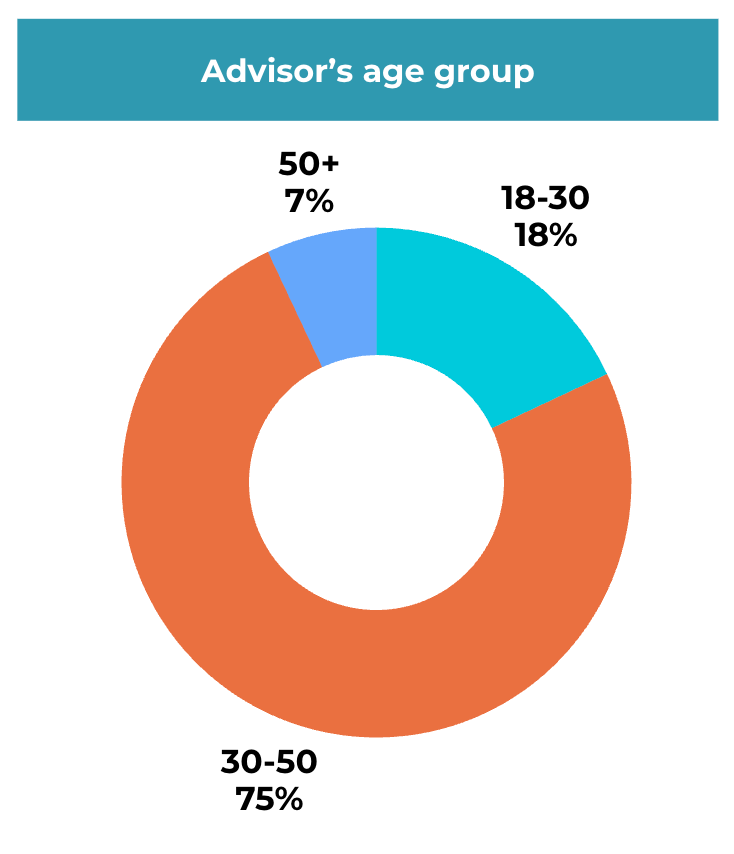
The vast majority of the advisors we met with (75%) were between the ages of 30 – 50. Another 18% of the advisors were under 30, and 8% were over 50 years of age.
Just under half of the advisors we talked to (45%) had 10+ years of experience in the advisory business. About 55% percent of advisors had less than 10 years of experience in the advisory business.

25 percent of the advisors we spoke with had a responsible investment, sustainable investment, or ESG investment certificate or related training. This does not necessarily mean that the individual was not knowledgeable about these issues, as they could have already possessed this knowledge or received in-house training on the topic from their employer.

About the Authors
Matt Orsagh
Matt Orsagh is a sustainable finance, corporate governance, and investment stewardship professional with extensive experience working at the intersection of capital markets, ESG integration, and long-term value creation.
Throughout his career, Matt has contributed to industry discussions related to:
sustainable investing,
corporate governance,
stewardship,
ESG integration,
climate risk,
and responsible investment practices within financial markets.
His work has focused on helping investment professionals, financial institutions, and market participants better understand the evolving role of sustainability within investment decision-making, governance, fiduciary duty, and long-term risk management.
Matt has collaborated with organizations and professionals across the financial sector on topics including:
sustainability disclosure,
investor stewardship,
ESG strategy,
governance best practices,
and sustainable finance workforce development.
His contributions emphasize the importance of practical implementation, strategic leadership, and operational readiness as sustainability expectations continue to evolve across capital markets and financial institutions.
Nawar Alsaadi
Nawar Alsaadi is the CEO and Founder of Kanata Advisors and a recognized leader in sustainable investing, ESG strategy, and responsible finance. With more than 20 years of experience in sustainability and investment management, he has held senior ESG leadership roles including Chief Impact Officer at ScopeFour Capital, and sustainability-focused positions at Canada Post Pension Plan and NEI Investments. Nawar specializes in ESG integration, impact investing, sustainable finance, and helping organizations align investment strategies with long-term environmental and social goals.
Maria Maisuradze
Maria Maisuradze, CFA is the Founder and CEO of ED4S (Education for Sustainability), a sustainable finance workforce readiness and education company serving financial institutions.
She has over a decade of experience across finance, treasury, investment operations, and sustainable finance education. Prior to founding ED4S, Maria worked in financial services roles spanning retirement planning, private equity operations, trading administration, and corporate treasury.
Maria has taught sustainable finance and ESG-related topics at institutions including London Institute of Banking & Finance and Université du Québec à Montréal.
She also serves on the board of the Concordia University Intergenerational Fund and was recognized as part of the Clean50 Clean16 Awards for Thought Leadership and Education.
Her work focuses on helping banks, insurers, asset managers, and advisory organizations strengthen sustainability competencies related to climate risk, ESG integration, sustainable investing, and workforce readiness.
About ED4S
At ED4S, we are dedicated to bridging the sustainability skills gap.
We achieve this by crafting innovative, flexible training solutions tailored for financial institutions.
Our programs are meticulously developed by experts in sustainable finance to address the growing demand for sustainability upskilling across diverse roles.
We have pioneered a simulation-based training solution to specifically address skill shortages among financial advisors. Our simulator enhances their expertise through practical scenarios, interacting with clients motivated by sustainability goals.
Our training is designed to empower broker-dealers to boost investments in sustainable products and equip advisors with the tools necessary to identify and seize new business opportunities.
Through these efforts, ED4S is at the forefront of advancing sustainability in financial practices.
If you wish to try our solutions, please email us at hi@ed4s.org.


