
Sustainability Capacity Building in Financial Institutions: ISSB, Climate Risk, ESG Integration, and Workforce Readiness
Updated: May 13

Executive Summary
Global ESG fund assets reached about $2.8 trillion at the end of 2022 according to Morningstar. The growth in ESG integration and sustainable investment is undeniable. and is here to stay.
With more sustainable funds than ever, there are more Chief Sustainability Officers at companies, more global regulation around the energy transition and sustainable investing, and more demand for sustainable investing products from investors.
We at ED4S wanted to better understand whether training at financial institutions was keeping up with the increasing demand for knowledge about ESG integration and sustainable investing from clients.
We surveyed 39 individuals from financial organizations around the world, representing $13.1 trillion in assets under management. The purpose of this consultation was to better understand the current state of sustainability training. What we found was, “It’s complicated.”
According to survey participants, the main challenges to providing sustainability training were :
Not a priority and resource constraints (34 percent)
Lack of time for employees to undertake such training (32 percent).
When given a hypothetical “magic wand” to design sustainability training that was fit for the purpose of their firm, most survey respondents said such training should focus on:
Climate risks (69 percent)
ESG integration (56 percent)
Risk and opportunities ( percent).
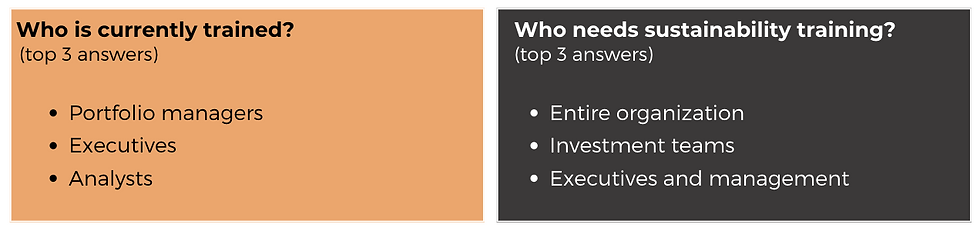
Sustainability training is most often focused on portfolio managers (70 percent), the firm’s sustainability team and executives (63 percent), and analysts (59 percent), though when asked who should get such training, the most popular answer by far, was the entire organization.
Our consultation admittedly has a bias towards sustainability-inclined firms by virtue of the survey subject matter.

Yet, despite this inherent bias, few of the firms we talked to had firm-wide sustainability education programs. This finding was not a surprise. We are still in the early days of incorporating ESG considerations into our day-to-day work. It is expected that many firms will “talk the talk” before they truly “walk the walk” of integrating sustainability throughout their organization.
As sustainability regulation increases and sustainable investing grows and evolves, we expect a trend of deeper and wider sustainability integration within companies and financial institutions. This heightened interest in sustainability is likely to lead to a material increase in the time and resources dedicated to sustainability training across industries.
We look at this survey as a snapshot of a fast-moving and developing sustainability landscape. If there is one finding that gives us tremendous hope as to the future of sustainability based on this consultation, it would be the indisputable passion of those interviewed and surveyed for deeper, better, and more applicable sustainability training.
Who participated in the Consultation?
Type of Organizations
Consultation targeted individuals in director and executive roles that have “ESG” or “Sustainability” in their title and worked in the financial services, asset management, insurance, and banking sectors. Other respondents worked at Credit Unions, NGOs, Credit rating agencies, or consulting firms.

Geography
Just over half of those surveyed came from an organization with primary operations in North America.
About 26 percent of those surveyed came from global financial organizations with another 21 percent coming from Europe and the United Kingdom.
Interpretation of Consultation
Most firms offer some form of sustainability training.
About two-thirds (64 percent) of survey respondents say that their firm offers some type of sustainability training. This training is most often a combination of in-house training and outsourced training.

The most often cited in-house training method we heard from our interviews involved internal sustainability experts giving periodic training to other staff at the firm.
At several large financial firms with global offices, training was often left up to each division, and training in one market differed from training in other markets. Such ad-hoc training was commonplace in many of the interviews we conducted.
“We need to focus on what is realistic and what can help our firm. We can’t do everything. Focus on what we can.”
- Pension Fund
A commitment to sustainability requires more buy-in.
When we asked survey participants; “If you had a magic wand and could design the perfect sustainability training, who would be trained?” 45 percent of survey respondents said, “The entire organization”, and the next highest answer, “The investment team” at 21 percent.
A similar focus on enterprise-wide training also emerged during our interviews. Many of those interviewed perceived company-wide training as essential to creating and reflecting a deep commitment to sustainability.
According to survey respondents, portfolio managers were the most likely to receive sustainability-related training, at a rate of 70 percent. This was followed by the sustainability team and executives (63 percent each) and analysts (59 percent).
“Sustainability needs to be part of the culture for training to really matter. To take hold, training should reinforce a culture that has sustainability baked into it already.”
- Asset Manager
Sustainability Foundations, ESG Integration, and Climate change are primary training topics.
Topics about foundations of sustainability, ESG integration, and climate change were the most prominent sustainability training themes within our surveyed cohort with “Foundational Training” chosen by 85 percent, climate risks by 48 percent, and ESG Integration by 37 percent. Diversity, Equity, and Inclusion (DEI) came fourth at 26 percent. Notably, DEI issues were often seen as a standalone sustainability topic and were often addressed through different resources and training channels. Training on Human Rights was a topic mentioned by 13 percent of those surveyed.

“Fiduciary duty requires trustees, executives, and advisors to prioritize the interests of their clients. This includes knowing your client (KYC) and your product (KYP) requirements to match the two adequately. Understanding clients’ interests and goals regarding environmental and social factors is increasingly seen as part of the good KYC process.” - Bank
What to prioritize with unlimited sustainability training resources.
We asked our participants what three sustainability topics they would prioritize if they had a free hand in shaping their firm’s sustainability training. They chose the following topics:
Climate Change (69 percent)
ESG Integration (56 percent)
Risks and Opportunities (49 percent).
These three topics were some of the broadest options available, showing that survey participants wanted to establish a broad understanding of sustainability among staff.
Outside of the top three topics, survey respondents desired more training on ESG regulation (26 percent) and ESG data and analytics (15 percent). With the sustainability data and reporting landscapes changing fast, it is not surprising that these two options were chosen by respondents. This came through in our conversations with survey participants, who acknowledged how challenging it is to keep up with current sustainability regulations and standards. Survey participants likely feel that these items should be included in a thorough sustainability training framework, but we limited them to three choices for the survey.
“I feel there is a need for more advanced training, especially on climate. It should be focused on data sources and how to use climate data in the investment process.” - Pension Fund
Sustainability training should be more integrated.
When we gave our survey respondents a magic wand and asked them how sustainability training should be conducted, they overwhelmingly stated that they thought sustainability training should be integrated into all training (58 percent).
This complements the belief from survey participants that sustainability training should be offered to the whole firm (45 percent).
This theme of deeper sustainability integration within a firm’s culture, processes, and strategy was a common thread across our survey and interviews.

Twenty-nine percent of those surveyed felt that sustainability training should be done at the pace of the learner, while eleven percent said that training should be conducted once a year.
Challenges to Sustainability Training
In conversations with survey respondents, we often heard that it was hard to justify more extensive sustainability training. Thirty-four percent of those surveyed mentioned that the main challenge of adopting sustainability training was that sustainability was not a priority or that budget constraints did not allow for more training. Thirty-two percent of those surveyed said that employees don’t have the time to engage in sustainability training.
It was rare to find a firm where sustainability training was provided for the entire organization (only 5 percent of firms), and that was never the case at large multinational financial institutions that we talked to. At such firms, sustainability training was mostly undertaken due to regulatory requirements, or to address the need of a specific set of professionals such as portfolio managers or analysts.
Our interviewees often cited sustainability training as a task confined to the sustainability team, rather than a strategic priority to be infused across the company culture and strategy.

“If it is just the sustainability team doing the work, our company will never reach net-zero commitments and we risk failing in our fiduciary duties.” - Global Investment Bank
The Frequency of Training is not Uniform
Due to the ad hoc nature of most sustainability training, the frequency of such training varied widely among the firms we assessed.
Thirty percent of those surveyed stated that sustainability training is ongoing but was folded within larger training and capacity-building efforts. All combined, nearly half of those surveyed (44 percent) stated that some combination of once-a-year, ongoing integration into broader training, and at-your-own-pace sustainability training was offered.
Most of the firms we talked to have not systematized sustainability training.
Firms that have more systematized training tend to have buy-in from leadership. Sustainability training at such firms has become a priority because it is woven into the culture of the firm.
“Training is sporadic. Our organization is global, with many departments. Each department has its own training priorities. The training is usually given by the internal sustainability team, which is very small. They have to take time from the jobs they should be doing to train everyone else. Training should be more uniform and consistent.”
- Global Investment Bank
Best-in-class sustainability training
Below are a few examples of practices from companies with some of the most advanced sustainability training programs.
ASSET MANAGEMENT FIRM
Our Sustainability training is very disaggregated and purposefully so. We have different teams that can be trained to what they need. First, we have a small corporate sustainability team that focuses on the reporting and disclosure side. Second, we have a public markets side where training focuses on the needs of asset managers. Finally, we have a private market team who all work with separate managers.
As a company, we take a high-level engagement view. Training has focused on training opportunities with partners – UN Global Compact, Project Drawdown, and others. Every second Friday of every month, we dedicate the second half of that day to learning. This education is self-directed, but we are promoting sustainability training to get our people up to speed.
We also have an impact agenda engagement series, one about every six weeks to learn about our climate action plan. Currently, about 7,000 employees participate in this educational offering. An internal climate expert hosts a “carbon fundamentals” series but is limited by his schedule.
BANKING INSTITUTION
Members of the sustainability team traveled to offices for in-person training. This way we can deliver a consistent message to 100-150 employees in leadership to educate them about the bank's approach to sustainability. This training is integrated into a broader 2–3-day seminar that covers multiple strategic topics. This includes a combination of an intro to sustainability, key concepts, and what the bank is doing. This training will have reached 600-700 people by this fall.
Once every two months we host virtual sustainability meetings for management and executive employees, which cover specific sustainability topics and are delivered by in-house subject matter experts.
We also have a formal online learning module currently in development, which will be part of mandatory training: 10 – 15 minutes, summarizing sustainability fundamentals.
Last year we created and launched company-wide mandatory sustainability training for the entire organization. This training covered general concepts of corporate social responsibility and was 30 minutes long.
Employees are encouraged to do training through outside vendors if desired. We are in the process of finalizing and deploying a business unit-focused training that is provided by a third party and was customized to include our own approach to sustainability.
The bank has launched a platform with informative videos on climate change and the loss of biodiversity. The bank has also developed a plan for in-depth ESG training to grow employee knowledge and better support members and clients in their own transition to a low-carbon economy. The bank has also launched training on responsible investing and insurance.


Report Methodology
ED4S sent an invitation to participate in market consultation to 750 sustainability professionals between July 24 and August 7th, 2023. The consultation ran until August 15, 2023. Thirty-nine sustainability leaders responded to the consultation for a response rate of 5.2%. Those that answered the survey have combined assets under management of approximately $13.1 trillion. ED4S consultation employed a comprehensive approach that involved a 20-question questionnaire to gather structured insights from respondents. Additionally, ED4S staff have conducted one-on-one consultations, fostering in-depth discussions and the opportunity to address nuanced perspectives, ensuring a holistic understanding of the subject matter. The report reflects these conversations, though ED4S does not name any individuals who participated in the survey.
Appendix
Percentages may not add to 100% due to Rounding
Survey questions and results
Type of organization
Bank | 26% |
Asset Manager | 21% |
Pension Fund | 21% |
Insurance Company | 15% |
Credit Union | 3% |
NGO | 3% |
Rating Agency | 3% |
Other | 8% |
Size of the Organization in terms of the number of employees
50,000 + | 13% |
20,000 – 50,000 | 15% |
5,000 – 20,000 | 8% |
500 – 5,000 | 33% |
100 – 500 | 26% |
Less than 100 | 5% |
Organizational main geographic presence
North America | 51% |
Europe & UK | 21% |
Oceana | 3% |
Global | 26% |
Which departments or groups are sustainability training targeting? (More than one answer allowed)
Portfolio Managers | 70% |
Executives | 63% |
Sustainability Team | 63% |
Analysts | 59% |
Sales | 48% |
Compliance | 41% |
Finance | 41% |
Risk Managers | 41% |
Human Resources | 37% |
Procurement | 33% |
External Stakeholders | 26% |
Which sustainability topics does the training focus on? (More than one answer allowed)
Foundational Training | 85% |
Climate risks | 48% |
ESG Integration | 37% |
DEI | 26% |
CSR | 22% |
ESG Reporting | 19% |
Frameworks and Standards | 15% |
Human Rights | 11% |
Is training done in-house or is it outsourced?
In-house | 41% |
Outsourced | 11% |
Combination | 48% |
What is the frequency of Sustainability training?
One time per year | 15% |
Ongoing- Incorporated into a broader training | 30% |
At your own pace (course attendance) | 11% |
Combination (depending on the group) | 44% |
What are the main challenges associated with offering sustainability training programs to employees (could select 2)
Not a priority or budget constraints | 34% |
Employees don’t have the time | 32% |
Too resource intensive to develop (time and cost) | 26% |
Do not know the sustainability training landscape | 24% |
Do not feel sustainability training programs offer enough quality content | 11% |
Is your organization considering future sustainability training for employees?
Yes | 63% |
No | 11% |
I Don’t Know | 26% |
If you had a magic wand – who would the training be for? (Only one answer)
The entire organization | 45% |
Investment teams | 21% |
Executives | 5% |
Clients | 5% |
Board of Directors | 5% |
Finance | 3% |
Communications | 3% |
Other | 13% |
Magic wand – What would be the priority topics that your selected group would be trained on? (Could Choose 3 answers).
Climate Change | 69% |
ESG Integration | 56% |
Risk and opportunities | 49% |
ESG Regulation | 26% |
ESG Data and Analytics | 15% |
ESG Frameworks | 13% |
Natural Capital | 10% |
Human Rights | 10% |
Magic wand – Duration of training
In-person instructor | 11% |
Online (self-paced) | 16% |
Internal with periodic in-house training sessions | 8% |
Combination | 66% |
Key Takeaways and FAQs
What is sustainability capacity building in financial institutions?
Sustainability capacity building refers to the development of sustainability, ESG, climate risk, governance, and sustainable finance competencies across financial institution teams.
Why is sustainability training important for financial institutions?
Financial institutions increasingly face regulatory, reporting, climate risk, governance, and client-related pressures requiring stronger sustainability competencies.
What sustainability frameworks should financial professionals understand?
Key frameworks increasingly include ISSB, IFRS S1, IFRS S2, TCFD, CSRD, ESRS, SASB, and OSFI B-15.
What is ISSB readiness?
ISSB readiness refers to an organization's preparedness to understand, implement, and operationalize sustainability disclosure requirements established by the International Sustainability Standards Board.
Why is climate risk literacy becoming important in banking and insurance?
Climate risk increasingly affects lending, underwriting, investment, governance, resilience, and long-term financial stability.
How can organizations improve sustainability workforce readiness?
Organizations can improve workforce readiness through practical, role-specific, and applied learning approaches focused on operational implementation rather than awareness alone.
About the Authors
Maria Maisuradze
Maria Maisuradze, CFA is the Founder and CEO of ED4S (Education for Sustainability), a sustainable finance workforce readiness and education company serving financial institutions.
She has over a decade of experience across finance, treasury, investment operations, and sustainable finance education. Prior to founding ED4S, Maria worked in financial services roles spanning retirement planning, private equity operations, trading administration, and corporate treasury.
Maria has taught sustainable finance and ESG-related topics at institutions including London Institute of Banking & Finance and Université du Québec à Montréal.
She also serves on the board of the Concordia University Intergenerational Fund and was recognized as part of the Clean50 Clean16 Awards for Thought Leadership and Education.
Her work focuses on helping banks, insurers, asset managers, and advisory organizations strengthen sustainability competencies related to climate risk, ESG integration, sustainable investing, and workforce readiness.
Matt Orsagh
Matt Orsagh is a sustainable finance, corporate governance, and investment stewardship professional with extensive experience working at the intersection of capital markets, ESG integration, and long-term value creation.
Throughout his career, Matt has contributed to industry discussions related to:
sustainable investing,
corporate governance,
stewardship,
ESG integration,
climate risk,
and responsible investment practices within financial markets.
His work has focused on helping investment professionals, financial institutions, and market participants better understand the evolving role of sustainability within investment decision-making, governance, fiduciary duty, and long-term risk management.
Matt has collaborated with organizations and professionals across the financial sector on topics including:
sustainability disclosure,
investor stewardship,
ESG strategy,
governance best practices,
and sustainable finance workforce development.
His contributions emphasize the importance of practical implementation, strategic leadership, and operational readiness as sustainability expectations continue to evolve across capital markets and financial institutions.
About ED4S
ED4S (Education for Sustainability)
Technology-Enabled Sustainability Training and Capacity Building
ED4S helps sustainability leaders and learning development teams to fast-track their sustainability training creation and deploymentlity capacity building in the financial sector. Leveraging the latest technology and the deep knowledge base of its world class sustainability subject matter experts, ED4S offers a large selection of customizable and engaging sustainability learning modules.
Our unique approach to partnering and co-creating with our clients allows our clients to build and maintain high-impact learning experiences that drive real organizational change. ED4S Academy courses, which have been taken by thousands of professionals, are highly rated and widely-recognized by numerous professional associations and educational bodies.
To learn more, visit www.ed4s.org