
Due Diligence in Sustainable Investing
- ED4S
- Aug 5
- 4 min read
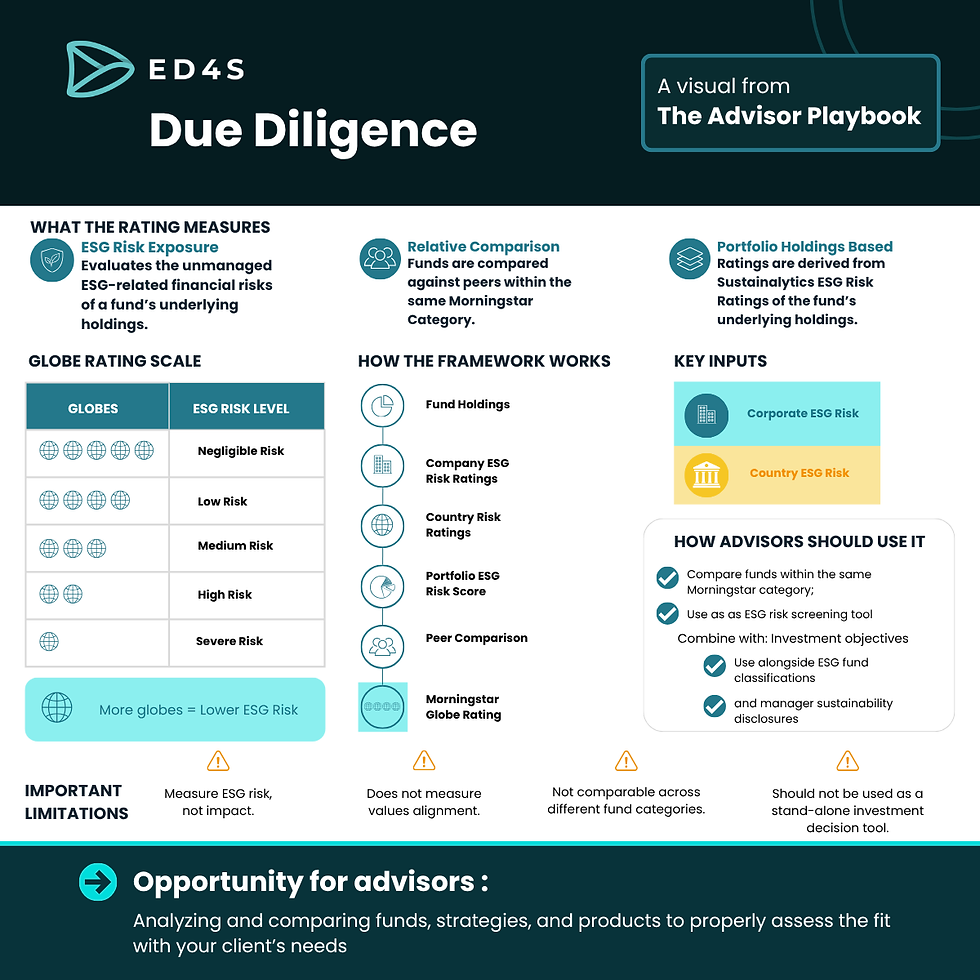
Due diligence matters in sustainable investing.
As outlined in the ED4S Sustainable Investing Advisor Playbook, evaluating sustainable investment products requires more than a simple revision of fund names, ESG ratings, marketing materials, or sustainability claims.
This matters because sustainable investment products can vary significantly.
Two funds may both be described as sustainable, responsible, ESG, impact-oriented, or transition-focused, and they may work in very different ways.
One may use exclusions, while another may integrate environmental, social, and governance factors into financial analysis. One may focus on a specific sustainability theme or rely heavily on stewardship and active ownership. Another may seek measurable environmental or social outcomes.
The label may be similar, but the investment approach may not be.
Why ESG Labels Are Not Enough
Sustainable investing has become more visible, but also more complex.
Product names, ratings, and marketing claims can help advisors begin their review, but they should not replace due diligence.
A fund with a strong sustainability label may still be unsuitable for a specific client. It may include companies the client expected to avoid. It may use a methodology the client does not understand. It may have higher concentration risk. It may lack the kind of reporting the client expects.
At the same time, another fund may have a less obvious label but better alignment with the client’s motivation, financial objectives, and portfolio needs.
That distinction matters.
The advisor’s role is not to assume that a label tells the full story, but to understand what the strategy of the investment actually entails.
What Can Differ Between Sustainable Investment Products
Sustainable investment products can vary across several important dimensions.
Methodology
Different products define sustainability in different ways.
Some focus on exclusions. Some prioritize financially material environmental, social, and governance factors. Some invest around long-term themes such as clean energy, water infrastructure, healthcare innovation, or climate adaptation. Some focus on measurable impact outcomes.
Advisors need to understand which approach is being used and whether it matches the client’s motivation.
Reporting quality
Not all sustainability reporting is equally clear or useful.
Some funds provide detailed reporting on holdings, methodology, engagement activity, emissions exposure, or impact indicators. Others provide only broad statements or high-level summaries.
For clients who care about transparency, reporting quality can be central to the recommendation.
Stewardship practices
Some sustainable investment strategies hold companies and use engagement, proxy voting, and active ownership to influence corporate behavior.
This can be appropriate for clients who want to encourage change from within.
But it may not satisfy clients who want to avoid certain sectors or activities entirely.
Advisors should be able to explain whether stewardship is part of the strategy and what it is intended to achieve.
Impact measurement
Impact-oriented strategies require particular care.
If a client wants measurable environmental or social outcomes, advisors should clarify what outcomes are being targeted, how they are measured, how often they are reported, and what evidence supports the claim.
Good intentions are not the same as measurable impact.
Why ESG Ratings Can Disagree
ESG ratings can be useful decision-support tools.
But they are not objective truths.
Different rating providers may use different data sources, assumptions, weightings, scoring models, and definitions of materiality. As a result, they may reach different conclusions about the same company or fund.
This can be confusing for clients.
It can also create communication risk if advisors treat a rating as a complete answer.
A more balanced approach is to explain that ratings are one input among many. They can support analysis, but they should be considered alongside methodology, holdings, risk, costs, reporting, stewardship, and client objectives.
Practical Questions Advisors Should Ask
Due diligence becomes more useful when it is structured around practical questions. A few examples include :
How does the strategy work?
Which sustainability approach is being used?
What does it include or exclude?
What trade-offs may exist?
How transparent is the reporting?
What evidence supports the sustainability claim?
How does the strategy compare to a benchmark?
What role would it play in the client’s portfolio?
Does it align with the client’s motivation, risk profile, time horizon, liquidity needs, and financial objectives?
These questions help advisors move beyond product language and toward informed recommendations.
They also help clients understand the strategy without being overwhelmed by technical detail.
Due Diligence and Suitability
Due diligence is not separate from suitability but supports it instead.
A product may be well-managed and still not be appropriate for a particular client. A strategy may have strong sustainability credentials and still create concentration risk, liquidity concerns, benchmark differences, or expectation gaps.
For example, a thematic climate fund may align with a client’s interest in the energy transition, but it may be too concentrated for their risk profile.
An ESG integration strategy may support long-term risk management, but it may not meet the needs of a client who wants full exclusion of certain industries.
An impact fund may appeal to a client’s desired outcomes, but the reporting may not be detailed enough to support the client’s expectations.
The question is whether the product fits with the client’s needs.
Helping Clients Navigate Complexity
Most clients are not looking for a technical lecture on ESG methodology.
They want practical guidance.
They want to understand what they own, why it was recommended, what trade-offs exist, and how the investment connects to their goals.
This is where advisors play an important translation role. They can explain the strategy in plain language, separate marketing claims from investment process, and clarify what a product does and does not do.
They can help clients make informed decisions without oversimplifying the topic.
Conclusion
Sustainable investing does not require advisors to have perfect answers; but it requires a disciplined process.
Due diligence helps advisors look beyond labels, ratings, and marketing language. It helps them assess whether a strategy’s methodology, reporting quality, stewardship practices, impact measurement, and portfolio role align with the client’s objectives and expectations.
A strong sustainability label may not be enough.
A less obvious product may sometimes be the better fit.
Due diligence helps turn sustainable investing from a product conversation into a suitability conversation.
That is where better advice begins.


